Viscount Hardinge & The Creation Of Aldershot Camp
By Paul H. Vickers, Friends of the Aldershot Military Museum
Henry Hardinge, 1st Viscount Harding of Lahore, was responsible not only for the initial moves to create an army camp at Aldershot but also was personally involved in the design and layout of the first barracks.
Born in 1785, Henry Hardinge was the son of a rector in Stanhope, County Durham. His military career began in 1799 as an ensign n the Queen’s Rangers in Canada. Returning to Britain in 1802 he served in various infantry regiments and in 1808 joined the force sent to Portugal to oppose the French of Napoleon. He was at the battles of Rolica and Vimiero, where he was badly wounded. However, he sufficiently recovered to be with Sir John Moore at the battle of Corunna (1809). Promoted to lieutenant colonel in 1811, Hardinge served under General Beresford at the battle of Albuera, and under Wellington at Salamanca (1812), Vittoria (1813), where he was again wounded, and in the advance into France in 1814.
In the Waterloo campaign of 1815 Hardinge, now a brigadier general, was attached as liaison to the Prussian army headquarters. At the battle of Ligny (16 June 1815) Hardinge’s left hand was shattered by a cannon ball and had to be amputated. Wellington wrote that Hardinge had received “the approbation of Marshal Prince Blucher and the officers of the Prussian headquarters, as well as mine, and I greatly regret his misfortune”.
After the Napoleonic Wars Hardinge pursued parallel military and political careers, becoming an MP in 1820, Clerk of the Ordnance (1823-1827), and Secretary at War (1828-1830) when Wellington was Prime Minister. He was Chief Secretary for Ireland (1830 and 1834-1835) and again Secretary at War under Peel (1841-1844). In his military career he was promoted to lieutenant general in 1841.
In 1844, aged 59, Hardinge was appointed Governor-General in India. When the First Sikh War broke out in 1845 Hardinge offered his service in the field as second in command to Sir Hugh Gough, the army commander in India, even though he was politically Gough’s superior. His cool temperament and vast military experience was a vital balance to Gough’s impetuosity, and was an essential factor in securing victory. After the war Hardinge was created a Viscount.
In January 1848 Hardinge returned to Britain, becoming Commander-in-Chief of the Army in 1852 after Wellington died. Hardinge took command at a difficult time, for the army was in dire need of reform as it was largely unchanged from how it had been after Waterloo. Despite his age (in 1852 he was 67) Hardinge energetically initiated improvements such as the introduction of Enfield rifles, heavier coastal artillery, and the establishment of the School of Musketry at Hythe. However, it was his recognition of the need for better training that led to the establishment of Aldershot Camp.
In 1852 the army was scattered around the country, most stations having no more than 1,000 men. As a result large scale exercises were difficult, a major problem when warfare at the time required manoeuvring of large formations. In January 1853 Hardinge persuaded the Secretary at War to allow large-scale exercises to be held that summer, for which two possible areas were surveyed, one around Aldershot and the other around Chobham. The “Camp of Exercise” was held in June at Chobham, with results which clearly showed that this sort of training was vital and should be repeated regularly. A permanent, large training camp was needed.
Chobham was not a suitable site, as the ground was boggy and had no adequate water supply. Hardinge remembered Aldershot and had visited the area himself in March and April 1853. In August, while the Chobham exercises were still underway, Hardinge rode over Aldershot Heath again. He decided the area was well suited for an encampment for a division, with more ground available for manoeuvres.
On 26 September Hardinge wrote a memorandum setting out the military reasons for a permanent camp at Aldershot. These included being able to concentrate a large body of troops “in the best possible position”, the economic benefits from having a dedicated training camp, and how a camp in this location would be of strategic importance to protect London from any enemy advancing from the south-west.
Hardinge secured the support of Prince Albert and the Prime Minister, Lord Aberdeen. In December 1853 the Chancellor of the Exchequer, William Gladstone, agreed to purchase the land. The acquisition of Aldershot Heath, along with surrounding land such as Long Valley, Cove Common and Ash Common for training grounds, continued throughout 1854.
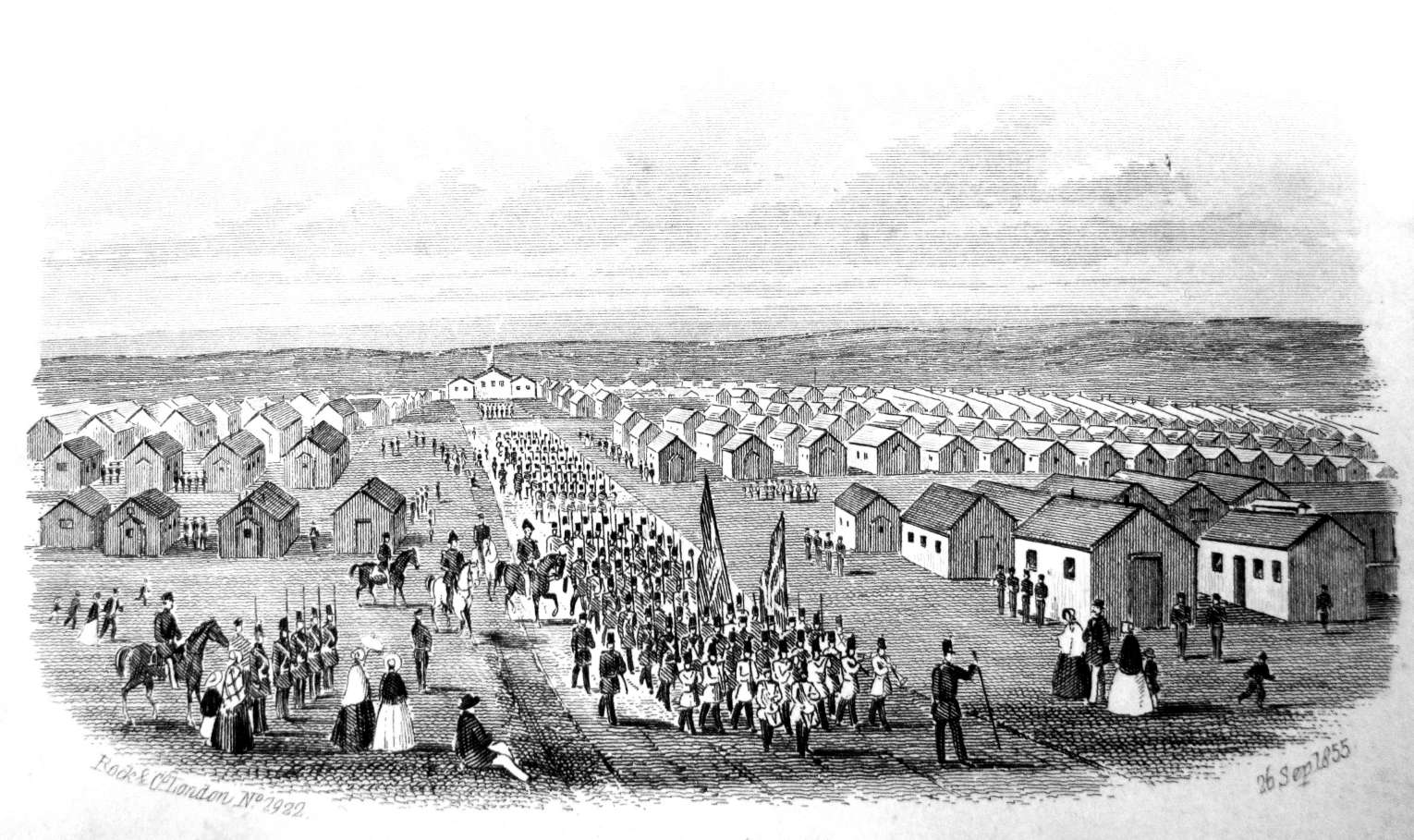
Hardinge visited Aldershot in February 1855 to decide personally the layout of the camp. He wrote: “I went down to Aldershot and marked out the ground for 20,000 militia, 12,000 on the south side of the canal and 8,000 on the north side and what with gas lighting – reservoirs of pure water – an office for the Staff and … other arrangements – all to be ready by the end of March”.
The original proposals had been for substantial permanent brick-built barracks in Aldershot, but owing to the outbreak of the Crimean War the plans were changed. Because of the urgent need for accommodation the buildings were now entirely wooden huts. The first units of militia moved into the camp in May 1855, followed by the first regular units the following month.
However, Hardinge, encouraged by Prince Albert, still wanted some permanent barracks. These would be in the south of the camp, and in a plan dated 28 September 1854 he proposed cavalry barracks to the west of the Winchester turnpike (now the A325), infantry and artillery to the east. However, after further consideration the plans were revised and all the permanent barracks moved east of the turnpike. Construction began in 1856 and all were completed by 1860.
The Crimean War proved a hard and difficult campaign, which revealed many of the shortcomings of the army. Although not in the field, as Commander-in-Chief Hardinge was responsible for areas such as equipment, stores, transport and medical arrangements. A Committee of Enquiry after the war was highly critical of its conduct. While most of the blame was placed on the field commander (Lord Raglan), the commissariat and the cabinet, Hardinge did not escape criticism.
On 7 July 1856, Hardinge travelled to Aldershot to present the Committee’s report to Queen Victoria who was staying in the Royal Pavilion. In her journal the Queen described what happened:
“While speaking to us … Ld. Hardinge nearly fell & gripped the table. Albert helped him to the sofa, & he continued his conversation, but we perceived that he was in great pain, & he said he had strained himself badly. He tried in vain to get off, & Albert went for Sir G. Wetherall, while I left the room. With difficulty poor Ld Hardinge was got into a carriage. Albert feared it was more than merely a strain …”
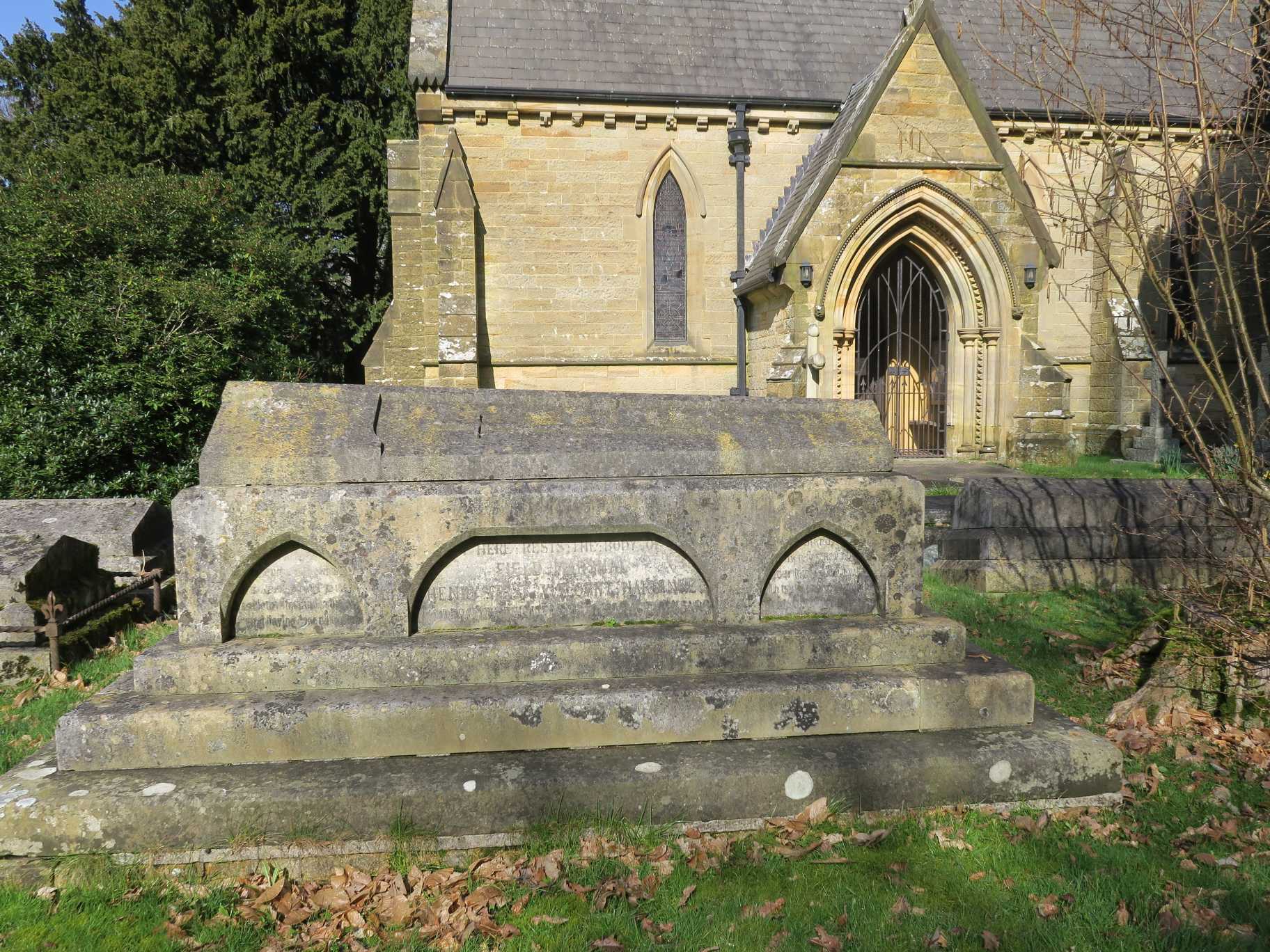
Hardinge had suffered a severe stroke and was taken back to his home, South Park near Penshurst, Kent. He never recovered and died on 24 September 1856 and was buried in the churchyard of Saint Peter’s Church, Fordcombe.
Unfortunately the Crimean War cast a shadow over Hardinge’s later years. However, he was an able and distinguished soldier. Wellington, who did not give praise lightly, said he was “a plain, straightforward, just and excellent man of business”. Hardinge should be remembered for initiating the essential reforms of the army in the 1850s, and the camp at Aldershot, the most significant garrison in the history of the British Army, is his lasting legacy.
Credits
Article originally published in the The Garrison, Spring 2025
Copyright © Paul H. Vickers. This article, including the accompanying pictures, may not be reproduced or republished, in whole or in part, either in print or electronically, including on any websites or social media sites, without the prior permission of the author.