Aldershot Camp Fire Brigades
By Paul H. Vickers, Friends of the Aldershot Military Museum
Fire was a constant threat in the Victorian camp. Most of the buildings were made of wood, heating was by coal fires or stoves, and lighting by oil lamps or candles, creating an ever-present risk of fire breaking out. Fire-fighting duties fell to a fire brigade formed from soldiers detached from their regiments and equipped with water pumps.
Unfortunately the inadequacy of these arrangements was soon evident. During the night of 8 December 1855 a fire broke out in the quarters of the commanding officer of the Antrim Rifles in H Lines, South Camp, caused by an overheated stove. Soon the fire spread to the neighbouring buildings. Although the fire brigade attended, there was no officer in charge to direct operations, no-one knew where the nearest water supply was to be found, and there were problems with the hoses. Lieutenant General Knollys, General Officer Commanding, noted that: “Owing to our change of regiments the trained firemen had left the Fire Brigade and marched with their Regiments - The few other were not up to this work and did not know how to fix the gear of the Engines properly, nor to apply to the exact spot for the fullest supply of water.” To remedy these problems Knollys applied to the Commander-in-Chief “to be allowed to retain the firemen permanently with a particular dress so as not to be confounded with the other soldiers”, and he gave orders that directions to every water supply were to be painted on the nearest building.
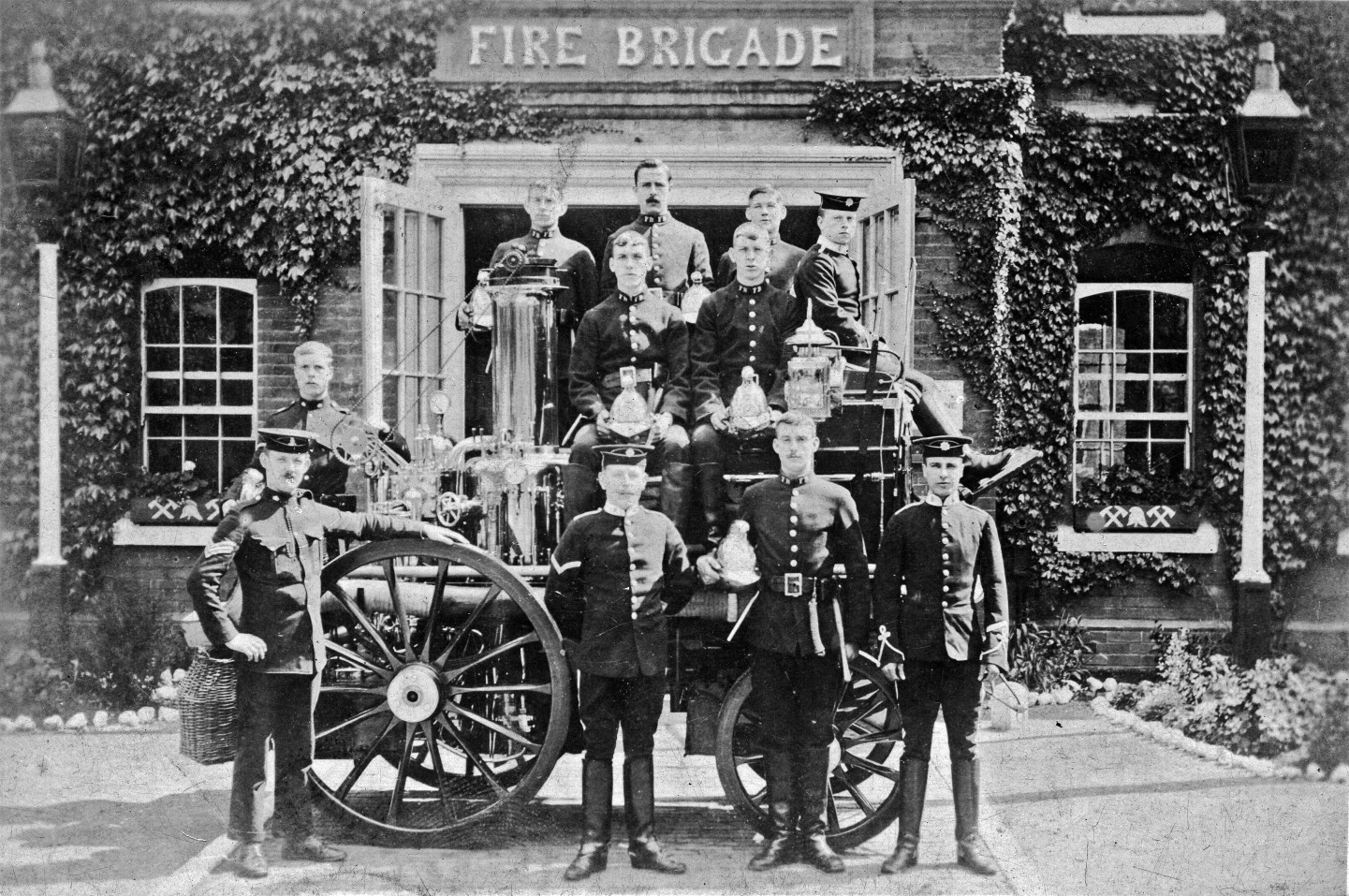
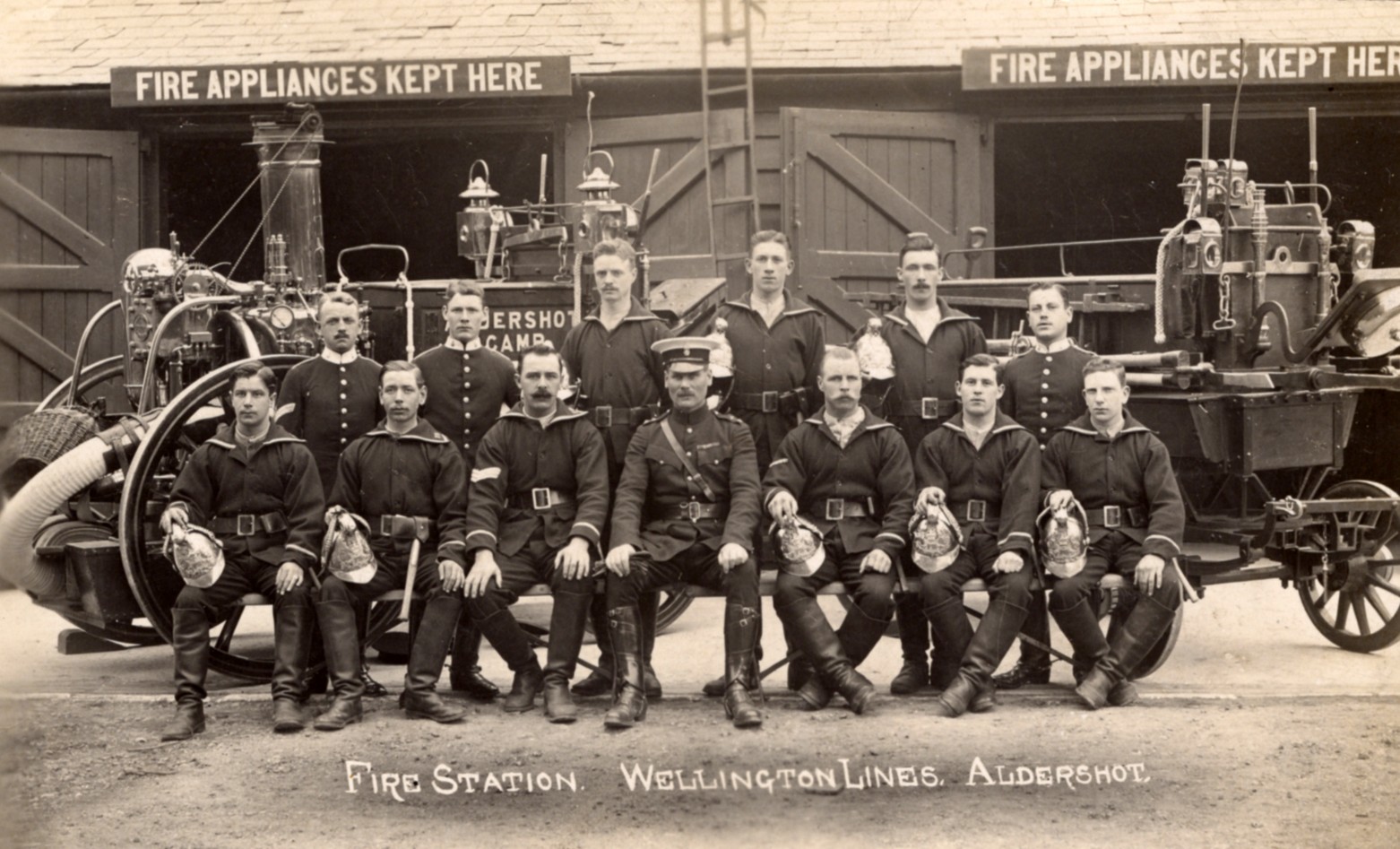
The most important reform was for soldiers detached for duty as fire fighters to remain with the fire brigade throughout the time their parent unit was in the Camp. The men were selected from many different regiments, so although some would depart when their units left Aldershot there was always a body of trained men available. Fire stations were established in North and South Camps, equipped “with engines, hoses, screens and other appliances”. The ‘screens’ were large metal sheets on wheels, used to isolate any burning building to prevent a fire from spreading.
The fire brigade was under the overall direction of the Commanding Royal Engineer, while in day-to-day command was a superintendent on the permanent staff of the Aldershot Division. The brigade consisted of one sergeant, one corporal and 21 privates, who were given extra pay for undertaking fire duties - the sergeant one shilling per day, the corporal eight pence and the privates four pence. Additionally, each regiment in the camp appointed one corporal and 12 men as a fatigue party, who could be called on if a fire broke out.
Numerous fires occurred in the wooden huts, which the fire brigade could deal with effectively. However, some more serious incidents tested their abilities. 1863 was a particularly disastrous year, with three major fires within a few months. The first occurred during the night of 7 July when the Commissariat Stores to the north-east of the canal caught fire, and spread to an adjacent barn which burned to the ground with all stores lost. Later that same month, at around one o’clock in the morning of 22 July, fire broke out in the officers’ mess in D Lines, South Camp. The officers evacuated the building and fortunately none were injured. Three fire engines attended and prevented the fire spreading to other buildings. In the early hours of 6 November 1863 there was a devastating fire in the stables of the Barrack Department which destroyed the building and tragically killed 76 horses, only seven could be saved. However an adjacent stable was saved and the horses turned loose.
The equipment available to the brigade was steadily expanded and improved. Sheldrake’s 1884 Guide to Aldershot said there were “thirteen first-class engines capable of throwing 100 gallons each per minute, six engines of two-horse power each, and there is also one to each regiment in the Camps and Permanent Barracks.” They also had two fire escapes which could reach up to 55 feet, enough to reach the roofs of the main infantry barracks.
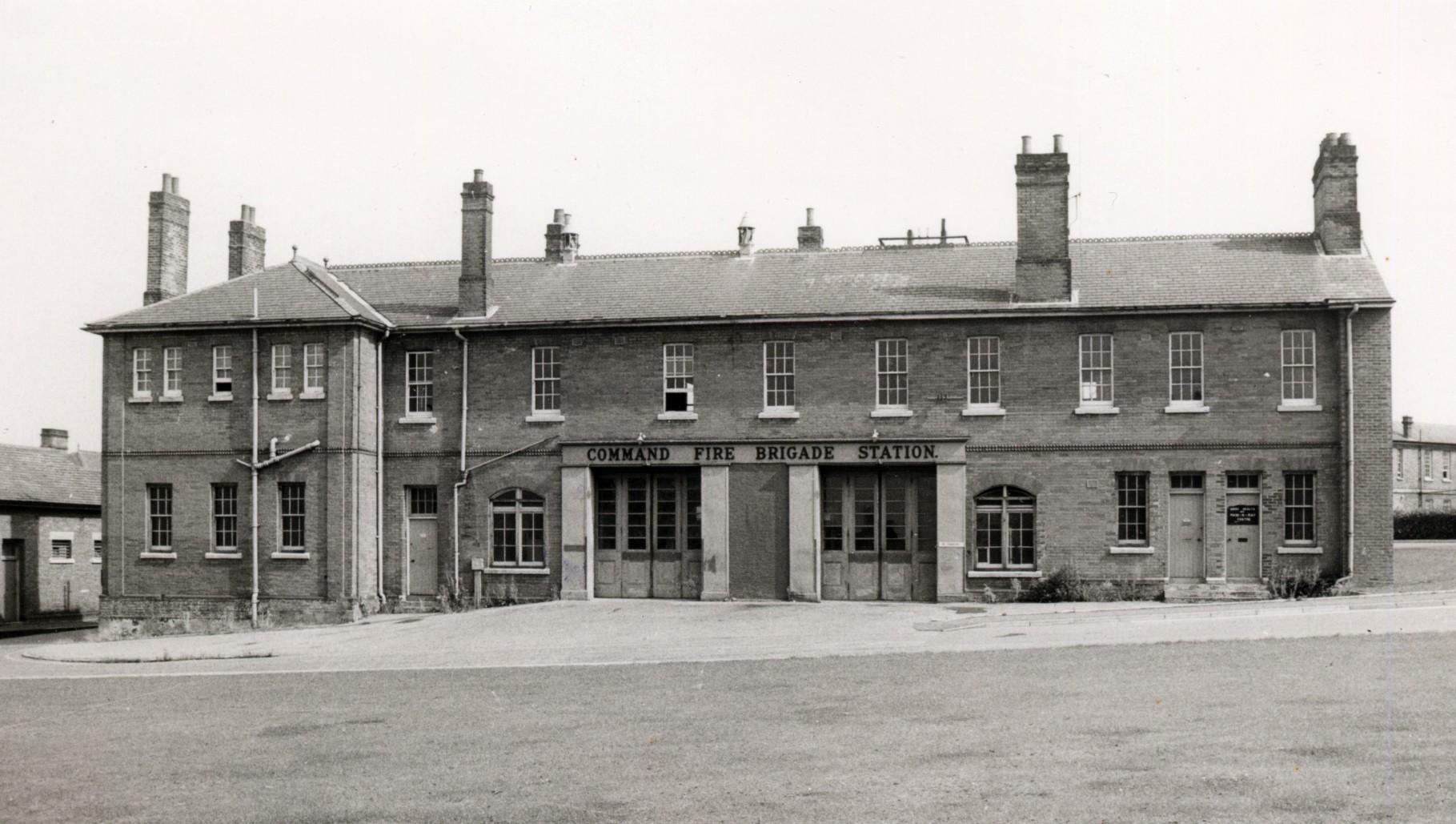
At this time the headquarter station was in P Lines South Camp, east of Queen’s Avenue between Scarlett’s Road and Hope Grant’s Road. With the re-building of the Camp in the 1890s new stations were built on Queen’s Avenue just south of the Clocktower School for North Camp, on the corner of Fire Station Road and Hospital Hill for Stanhope Lines, and in Salamanca Barracks for Wellington Lines and the Cavalry Barracks. Around 1905 the brigade received its first ‘Fire King’ self-propelled steam fire engine, and by 1910 it had three Shand Mason engines.
Mr Noble was a boy in the camp just before the First World War and remembered that the North Camp Fire Station had a motorised fire engine but also kept a horse-drawn appliance. The harness was suspended above the horses, keeping the weight off the animals but ready to drop down in case of an alarm. The horses were trained and ready, for Noble recalled: “as soon as the harness went down they were off, never mind whether anybody was with them, or anything else, they were off … And with the terrain as it was then … they could get to places where the motor couldn’t.”
Fire could break out in the camp’s major buildings. In February 1883 timely action by the fire brigade saved the Garrison Church of All Saints (see article in the Aldershot Garrison Herald, issue 20, June/July 2018), and in January 1903 a fire at Government House destroyed all the building above the ground floor (see article in The Garrison, issue 26, Autumn 2025).
A few years later a major fire occurred in the Army Pay Office in Union Buildings on Hospital Hill, probably started when some coals in the Cashier’s office set fire to the floor. The alarm was raised around three o’clock in the morning of 28 February 1907, all units of the camp fire brigade were soon on the scene, and by six o’clock had the situation under control. All the first floor in the centre of the southern block was lost and the ground floor badly damaged. Under the deed by which the army had acquired the building they had to reconstruct it to the same design as the original. This was done faithfully, with only minor details identifying the post-fire restoration.
In the Second World War the Garrison Fire Brigade was replaced by a new army-wide service. Until this time there was no unified army fire service, each of the larger garrisons organised its own fire brigades. In 1941 a fire-fighting wing was formed within the Royal Pioneer Corps, which absorbed all those employed on full-time fire service duties. The Pioneer Corps Fire Fighting Wing operated throughout the war until disbanded on 1 July 1946, when the Army Fire Service was integrated into the Royal Army Service Corps.
The rebuilding of the camp during the 1960s removed the last vestiges of the garrison fire brigade. In 1961 the government decided that fire protection for UK barracks would be the responsibility of the civilian services. Standing orders now stated that if a fire occurred the guard commander or duty policemen would call out the civilian brigade. At this time the local Fire Brigade was based in a station next to the Aldershot Town Hall in Grosvenor Road, but in 1972 it was moved to Ordnance Road, and then in 1990 to its current station in Lynchford Road.
All the garrison fire stations were demolished, but the work of the gallant army fire fighters is remembered by the name of Fire Station Road in the Wellesley estate, marking the location of the Stanhope Lines Fire Station.
Credits
Article originally published in the The Garrison, Winter 2025
Copyright © Paul H. Vickers. This article, including the accompanying pictures, may not be reproduced or republished, in whole or in part, either in print or electronically, including on any websites or social media sites, without the prior permission of the author.