The Sudan, Camel Corps and Gordon
By Paul H. Vickers, Friends of the Aldershot Military Museum
The article on the Prince Consort’s Library in “The Garrison” issue 24, Spring 2025, described how the library had copies of old Army manuals on the use of camels. Aldershot has a surprising significance in the use of camels in the Army, for it was one of the centres for the formation of the Camel Corps in 1884.
The creation of this unusual unit was caused by the need to despatch an expedition to the Sudan. In 1878 Britain had taken virtual control of Egypt (which was nominally part of the Ottoman Empire) in order to protect access to the Suez Canal, a strategically important route to India and the Far East. In 1882 a revolt broke out in Egypt against foreign rule, which was suppressed by a British force of 35,000 men commanded by Lieutenant-General Sir Garnet Wolseley. Although the Egyptian Khedive was ostensibly restored to power, the British remained in Egypt to ensure the government remained co-operative.
By occupying Egypt, Britain now also had responsibility for the neighbouring Sudan, which had been under Egyptian rule. In Sudan an Islamic revolt had begun in 1881, led by Mohammed Ahmed, who styled himself the ‘Mahdi’ or ‘divinely guided one’. By the end of 1882 the Mahdists controlled much of Sudan. They annihilated an Egyptian force of 10,000 near El Obeid (5 November 1883) and another at Suakin on the Red Sea coast (January 1884). A British-Indian force of 4,000 men under Major-General Gerald Graham won hard-fought victories at the battles of El-Teb (29 February 1884) and Tamai (13 March 1884). However, the Mahdists quickly recovered and Graham was forced to withdraw. The remaining Egyptian garrison at Khartoum now assumed critical importance.
In command in Khartoum was Major-General Charles Gordon. A famous figure in Britain, Gordon came to prominence from his command of a mixed force of British, French and Chinese imperial troops fighting rebels in China in 1862-64. He served as Governor-General in Sudan from 1877 to 1879, when he vigorously tried to suppress the local slave trade. When news of the Mahdist victories reached Britain there was public demand for Gordon to be sent back as the man to save Khartoum.
Gordon arrived at Khartoum on 18 February 1884. Although instructed to evacuate the garrison, he decided to stay and defend the city. In March Khartoum was surrounded by the Mahdists, and communications cut off in April.
Britain was forced to organise a relief expedition to rescue the besieged Gordon. This was again commanded by Wolseley. He wrote: “In my little wars I generally hit upon some novel expedient … This is now the case with my boats and Camel Corps.” The boats he mentioned were used to transport a force of 2,500 British troops, 210 Egyptians, and 350 Sudanese, plus 200 civilians, up the Nile river to Khartoum.
Wolseley’s other “novel expedient” was the Camel Corps. Fearing that it would take too long to reach Khartoum by river, a second column would travel overland by a faster, but more dangerous route across the desert. In September 1884 Wolseley proposed the creation of a Camel Corps from detachments of volunteers from the Foot Guards (40 men each from 7 battalions), Household Cavalry (100 men from 3 regiments), line cavalry (40 men each from 16 regiments), and Rifle Brigade (80 men from 2 battalions). Among the regiments asked to provide detachments were the three cavalry regiments stationed in Aldershot: the 2nd Dragoon Guards (Queen’s Bays); 7th Hussars; and 20th Hussars. Sheldrake’s Aldershot Military Gazette reported that “twice as many volunteers … stepped forward as were required.”
All the cavalry Camel Corps volunteers from around the country assembled at Aldershot, temporarily accommodated in the West Infantry Barracks. No horses were brought with them, as they would be mounted on camels once they reached Egypt. The men formed into Heavy and Light Divisions and were issued with a new uniform consisting of white tropical helmet, scarlet loose-fitting tunic, and corduroy riding breeches. The Corps would use camels for speed of mobility, but in action they would fight on foot. Consequently they were armed with the infantry Martini-Henry long rifle and bayonet, and had rapidly to learn the long rifle drill. In addition to the standard ammunition pouch they wore a bandolier over the shoulder holding another 50 cartridges, along with a haversack and water bottle.
On Thursday 25 September the Duke of Cambridge, Commander-in-Chief of the Army, visited Aldershot and inspected the Camel Corps on Queen’s Parade. Next day the Corps, consisting of 44 officers and 819 NCOs and men, left the garrison, accompanied by 2 NCOs and 6 privates from the Army Hospital Corps. They marched to Aldershot station behind the bands of the Cavalry Brigade, “the route being lined with spectators and great enthusiasm displayed …The men were in good spirits as was evident by their repeated cheering”. Special trains took them to Portsmouth, where the Heavy division embarked on the troopship ‘Deccan’ and the Light on the troopship ‘Australia’.
A detachment of 4 officers and 129 NCOs and men from the Army Hospital Corps also left Aldershot on 25 September, heading for Woolwich Arsenal from where they left by ship for Egypt. A Surgeon and another 50 NCOs and men of the Army Hospital Corps departed on 29 September for Portsmouth Dockyard, where they embarked with the Light Division of the Camel Corps. Other Aldershot units sent to Sudan included the 20th Hussars, Queen’s Bays, and detachments of Royal Engineers.
Wolseley’s relief column set off in October 1884. On 17 January 1885 the desert column was attacked by the Mahdists at Abu Klea. The Mahdists succeeded in penetrating the British square, which was closed only after desperate hand-to-hand fighting, The British suffered 168 casualties, the Mahdists around 1,100. The column reached Khartoum on 28 January 1885, but it was too late. Two days earlier the Mahdists had stormed the city and Gordon had been killed.
The failure of the relief expedition was a national humiliation which was only alleviated by making Gordon into a tragic hero. A Mahdist invasion of Egypt was defeated during 1888-1889, but it was not until 1896 that the Sudan was re-conquered.
Despite the failure of the Khartoum campaign, the soldiers received a warm welcome on their return to Aldershot. The first of the Camel Corps detachments to arrive was the Queen’s Bays, who were met at the railway station on 16 July 1885 by the regimental band and a large crowd who followed them back to the East Cavalry Barracks. “Here deafening cheers were given for the gallant fellows who had performed such heroic deeds on the banks of the distant Nile”, reported Sheldrake’s Aldershot Military Gazette. “Notwithstanding the roughness of their ‘rig-out’ the men looked remarkably well … The hilarity of the men was only tempered by the remembrance of the poor fellows whom they had left behind buried in the sand beneath the tropical sun of the Soudan.”
The 7th and 10th Hussars were met with similar enthusiasm when they returned to camp on 24 July. “A large number of persons accompanied the troops to their respective barracks, the bands of their regiments heading each of the gallant little parties. The men all appeared in good health and spirits, and were apparently but little the worse for the campaign they had been through.”
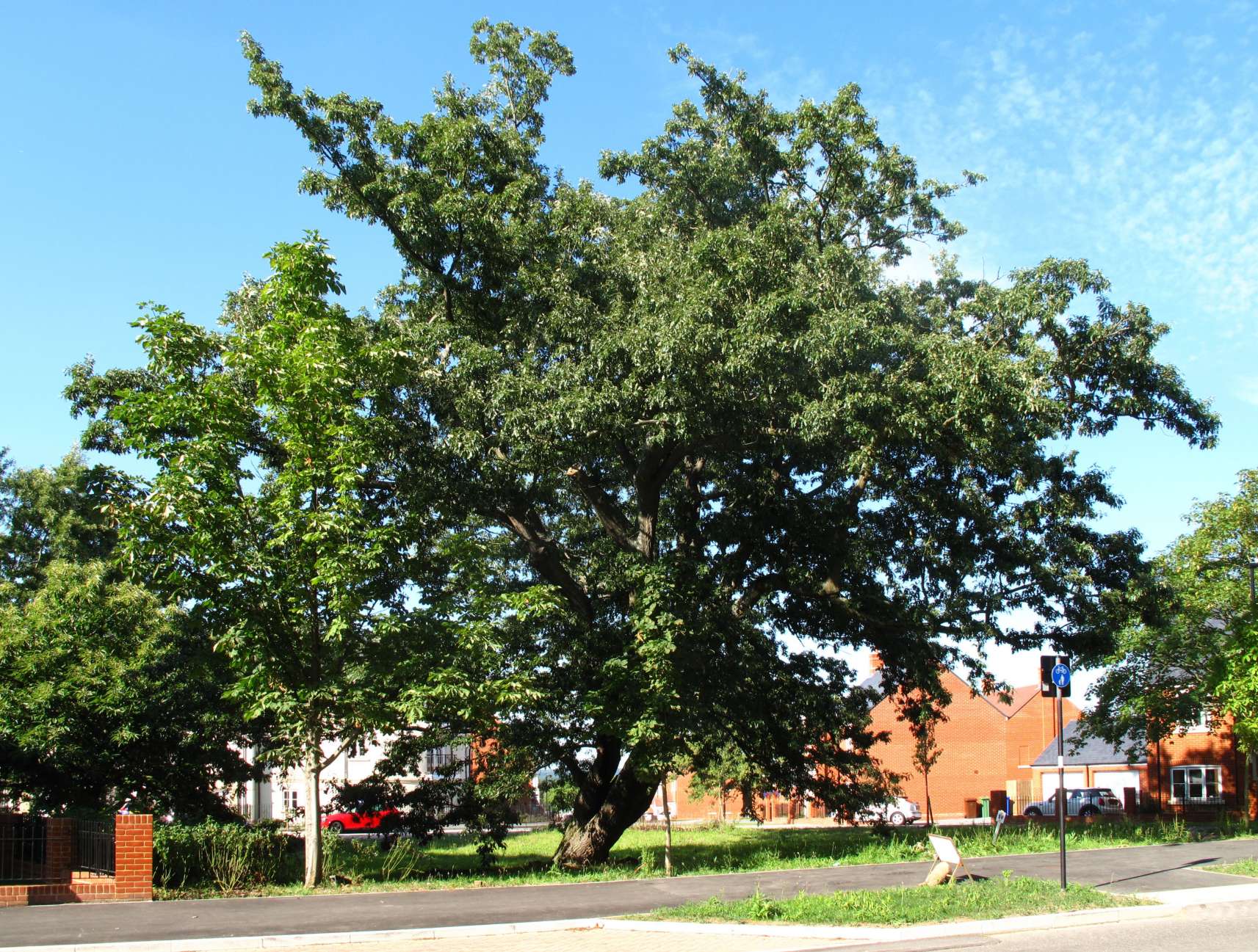
The Sudan campaign is remembered in Aldershot by the Gordon Oak. General Gordon was deeply religious and he visited the Holy Land in 1883, from where he brought back a Jerusalem Oak tree. This was planted in Aldershot to symbolise “endurance, strength and triumph in the Home of the British Army”, and it is now a fine mature tree on the north side of Hospital Road. In Aldershot town there is also Gordon Road, another lasting reminder of the events of 1885.


Credits
Article originally published in the The Garrison, Summer 2025
Copyright © Paul H. Vickers. This article, including the accompanying pictures, may not be reproduced or republished, in whole or in part, either in print or electronically, including on any websites or social media sites, without the prior permission of the author.